
Mayor Mike Johnston is not very popular with Denver’s bike community right now, according to the results of City Cast Denver’s first-ever Denver Bike Community Poll — which yielded a veritable peloton of provocative data and fascinating personal stories. Our hope was that these results would elevate the next bike-related policy debate, and we were delighted to find they also tell a broader story about what it’s like to ride a bike in Denver in 2026.
We will have the full results, analysis, and charts available for perusal at Denver Bike Fest on Saturday, June 13, 3-9 p.m. Bike Fest is free, with lots of live music and food trucks, and we’ll be emceeing the stage. Come out and say hi!
For additional analysis, we have also invited an independent expert — State Director for GreenLatinos Colorado Ean Thomas Tafoya – to comment on the results presented throughout. He has worked on a wide variety of public policy issues in the realm of transportation, most recently a years-long effort to create a free, public transportation option to and from Red Rocks.
A quick note on the methodology before we get into the rest of the results: The City Cast Denver team created this survey and distributed it via the City Cast Denver podcast, newsletter, and Instagram account throughout the month of May 2026. The team also reached out to more than two dozen local bike community organizations, shops, journalists, advocates, and social media groups to solicit more responses. Anyone who self-identified as a Denver bike rider was invited to participate, and 460 respondents filled out the survey. According to our independent analyst Ean Thomas Tafoya, that’s a “large sample size.”
Let’s Start With the Mayor.
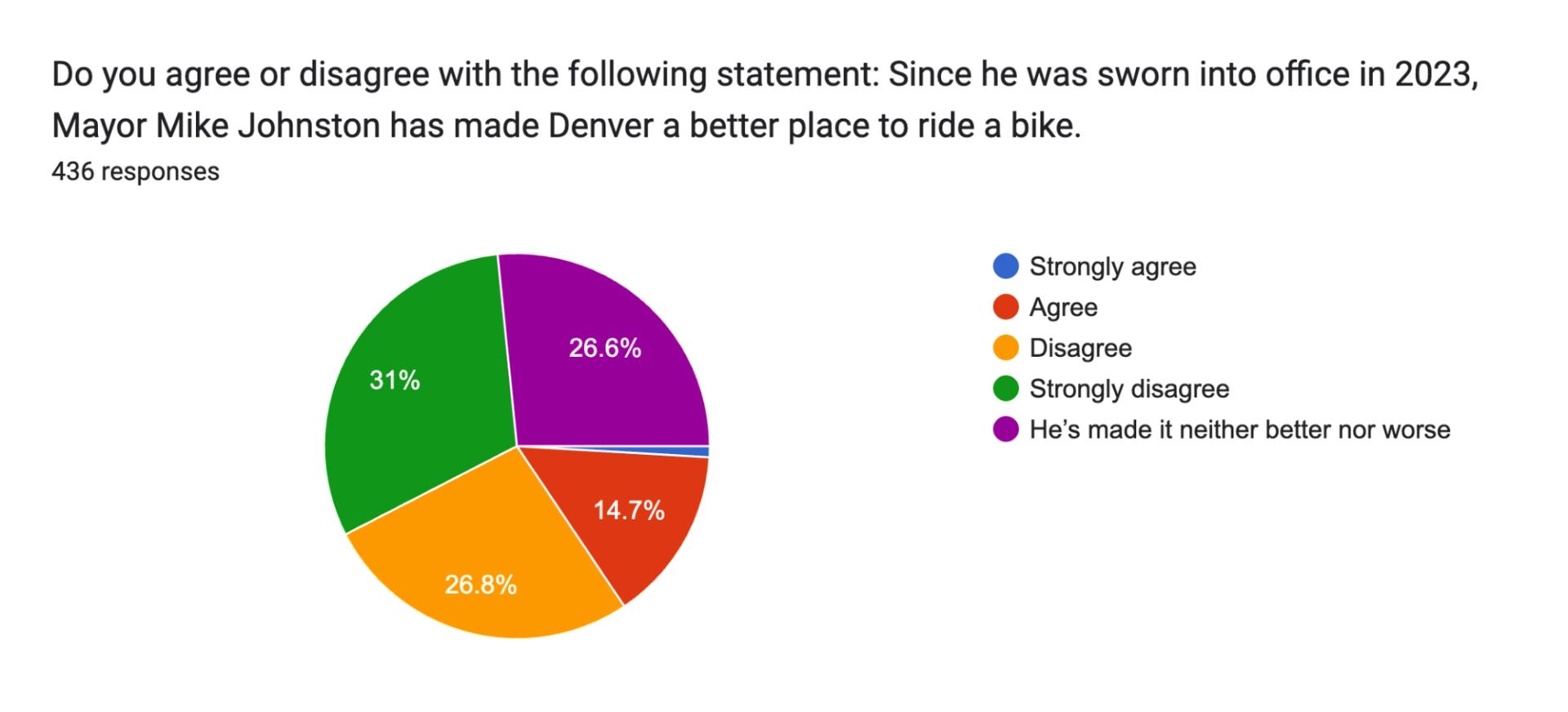
Only 15.6% of the 460 respondents to our survey agreed with the assertion that Mayor Mike Johnston has made Denver a better place to ride a bike. A majority of respondents either disagreed or strongly disagreed with that statement, with the most popular answer being “strongly disagree” at 31%.
When asked to elaborate on their response to that question, many respondents who disagreed offered additional criticism. "The Johnston administration and his [Department of Transportation and Infrastructure] team seem actively hostile to Denver cyclists and have worked to reduce planned protected bike lanes and have actually removed existing protections," wrote one respondent. "[DOTI executive director] Amy Ford needs to be fired."
Another wrote: "I certainly didn't think he would be worse than [former mayor Michael] Hancock on mobility issues. But he really is."
Who Do These Results Represent?
The majority of respondents identified their race or ethnicity as white (90.8%), with 8.3% identifying as Hispanic or Latino, 2.9% as Asian, 2.2% as Black or African American, and no other group with more than 10 respondents. That is much whiter than the population of the Denver metro area overall — 64.6%, according to the U.S. Census Bureau.
Similarly, the respondents skew more male than the Denver metro overall (respondents were 57% male, 38.3% female, and 6.1% genderqueer, genderfluid or nonbinary). They are also relatively more affluent (51.2% said they make more than $100,000 per year) and more educated (91.9% hold a bachelor’s degree, graduate degree, or PhD).
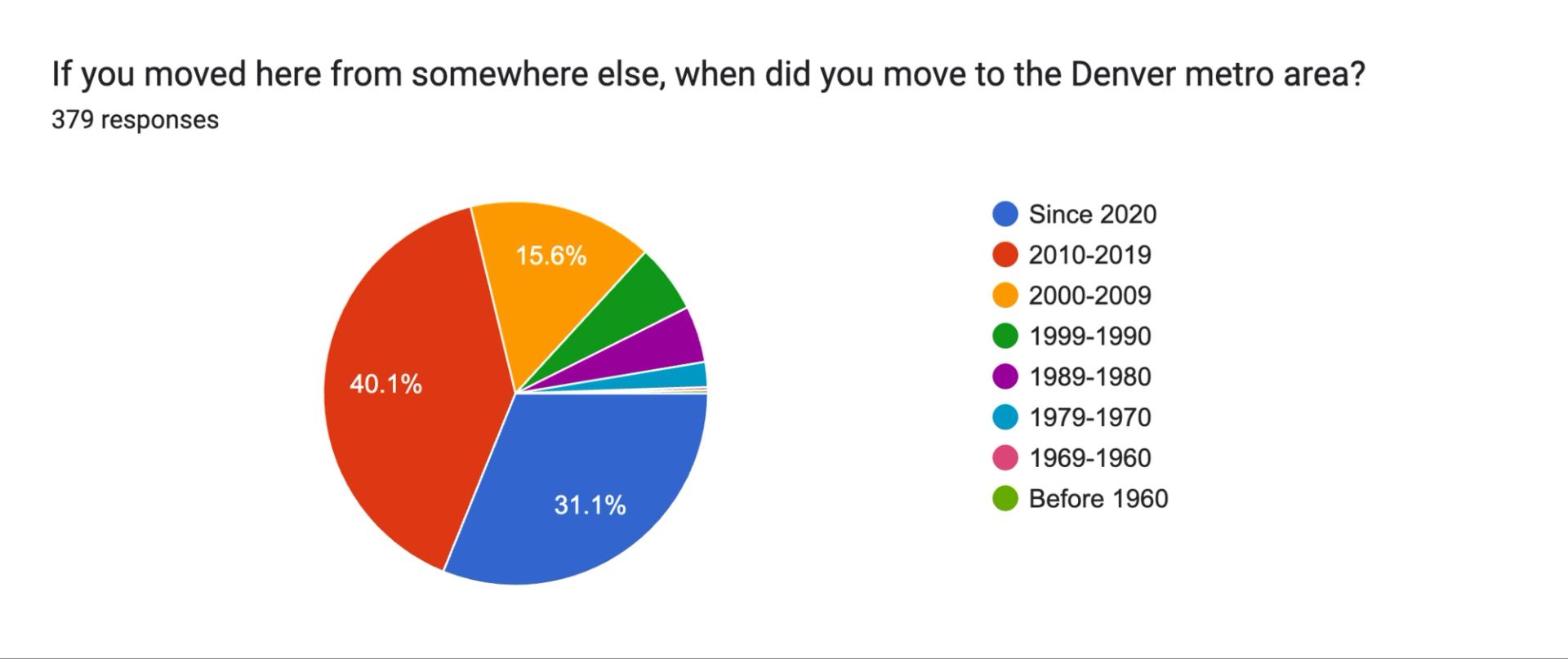
Just over 80% of respondents said they were not born in the Denver metro area, with 71.2% reporting having moved here since 2010.
Is Riding a Bike in Denver Safe?
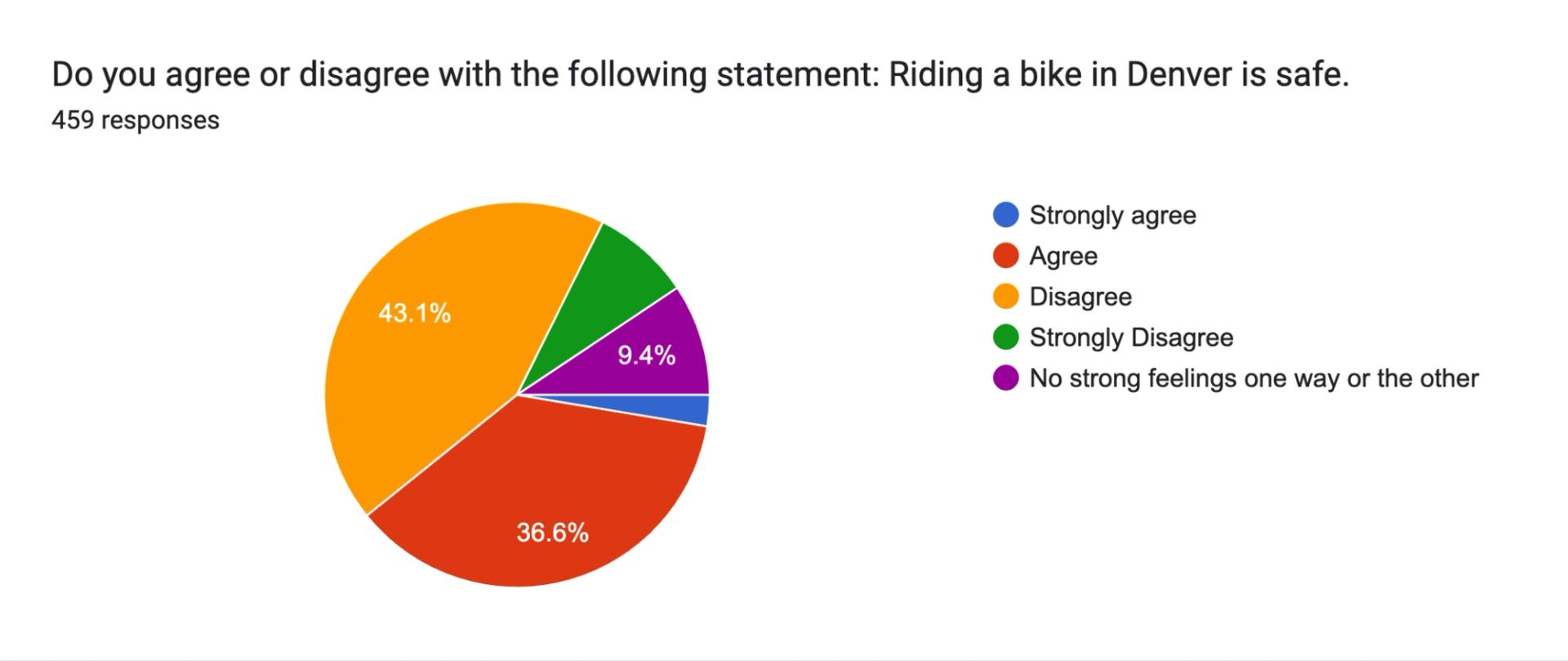
A majority of respondents said “no” — 51.4% either disagreed (43.1%) or strongly disagreed (8.3%) with the assertion that riding a bike in Denver is safe, while only 33.9% agreed or strongly agreed. The remaining 11.8% had no strong feelings either way.
In open-ended follow-up responses, riders cited a consistent set of grievances: inattentive and aggressive drivers, unprotected or disconnected bike lanes, and a culture that puts cars first. "Drivers see me as less than human," wrote one respondent. "Paint is not protection," another noted, calling for safety improvements to existing bike lanes. Another noted simply: "I almost get hit by a car somewhat regularly, even with designated bike lanes."
Many respondents drew a sharp distinction between the city's off-street trail network — widely praised — and the on-street bike lane infrastructure, which was frequently described as incomplete, inconsistent, and dangerous at intersections.
One respondent connected safety issues to the demographics of Denver’s bike-riding community: “While I may be fairly comfortable, the fact we don’t see more youth and womxn on bikes is because the infrastructure is disjointed and not high-comfort. Add on the fact we have vehicles getting larger and heavier all over the country and have to fight against car-brain culture.”
How Have E-Bikes Changed the Game?
While the City of Denver has shifted priorities for its wildly popular e-bike rebate program (it is now only available to residents making less than 100% of the area media income), the city and state rebates have made e-bikes a common sight on Denver streets. But according to our survey, non-e-bikes are still more popular, with 59.3% of respondents reporting that they ride only non-e-bikes and only 11.5% exclusively riding e-bikes.
Tafoya, on the other hand, sees the 40.7% of this sample of bike riders who either said they ride an e-bike exclusively or both. “That feels right to what I see in market adoption in Denver,” he added
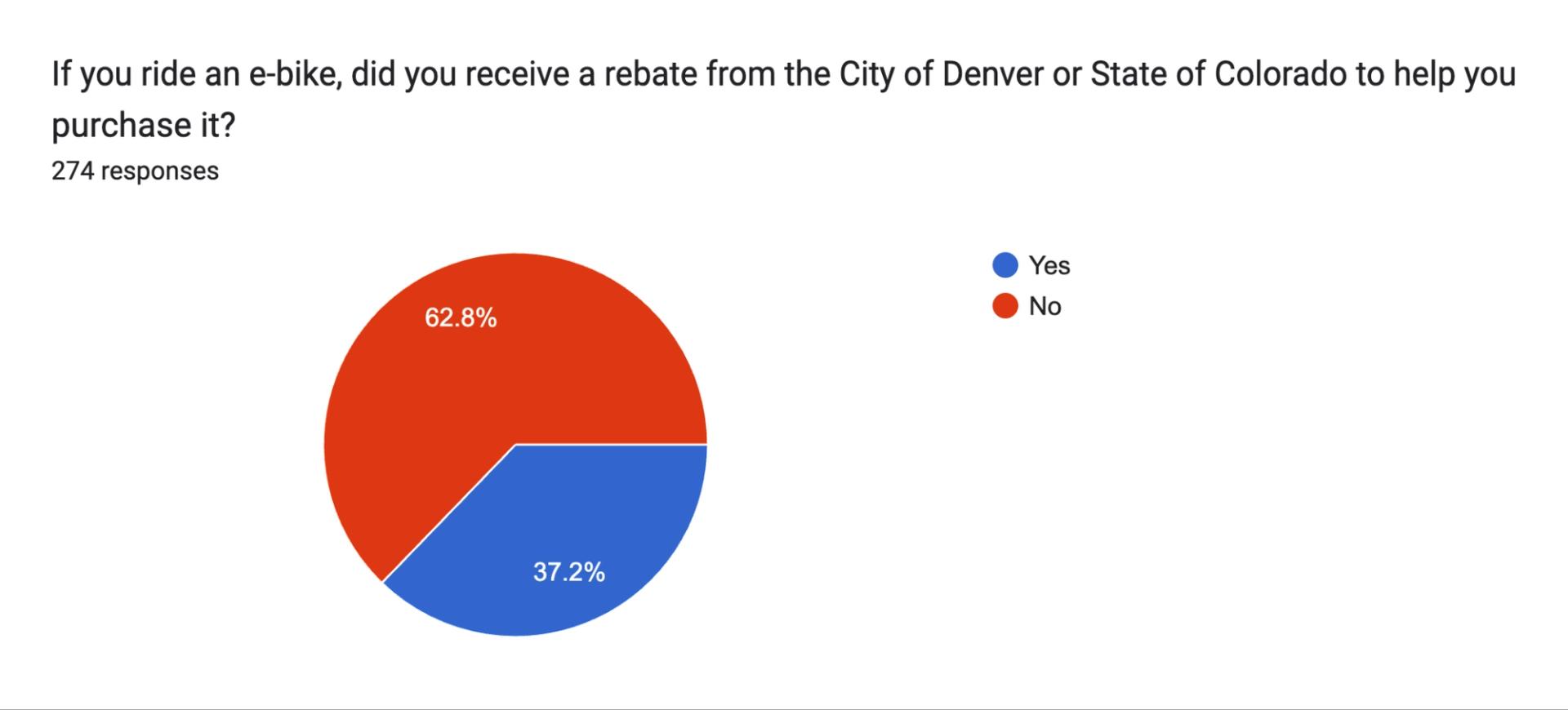
He also noted that “the incentives aren't a majority of the purchases,” as you can see in the chart below.
Tafoya also identified one respondent’s comment connecting the proliferation of e-bikes (and other new micromobility options) with the issue of safety: "Rental e-scooters and e-bikes create an environment of inexperienced and reckless riders.”
“I think this is true, and that rider education is important for children and adults alike,” Tafoya added. “Defensive riding, much like defensive driving courses, prepare us all to make it home safely, which is the number one goal of our whole transportation system.”
What Do People Who Ride Bicycles Want?
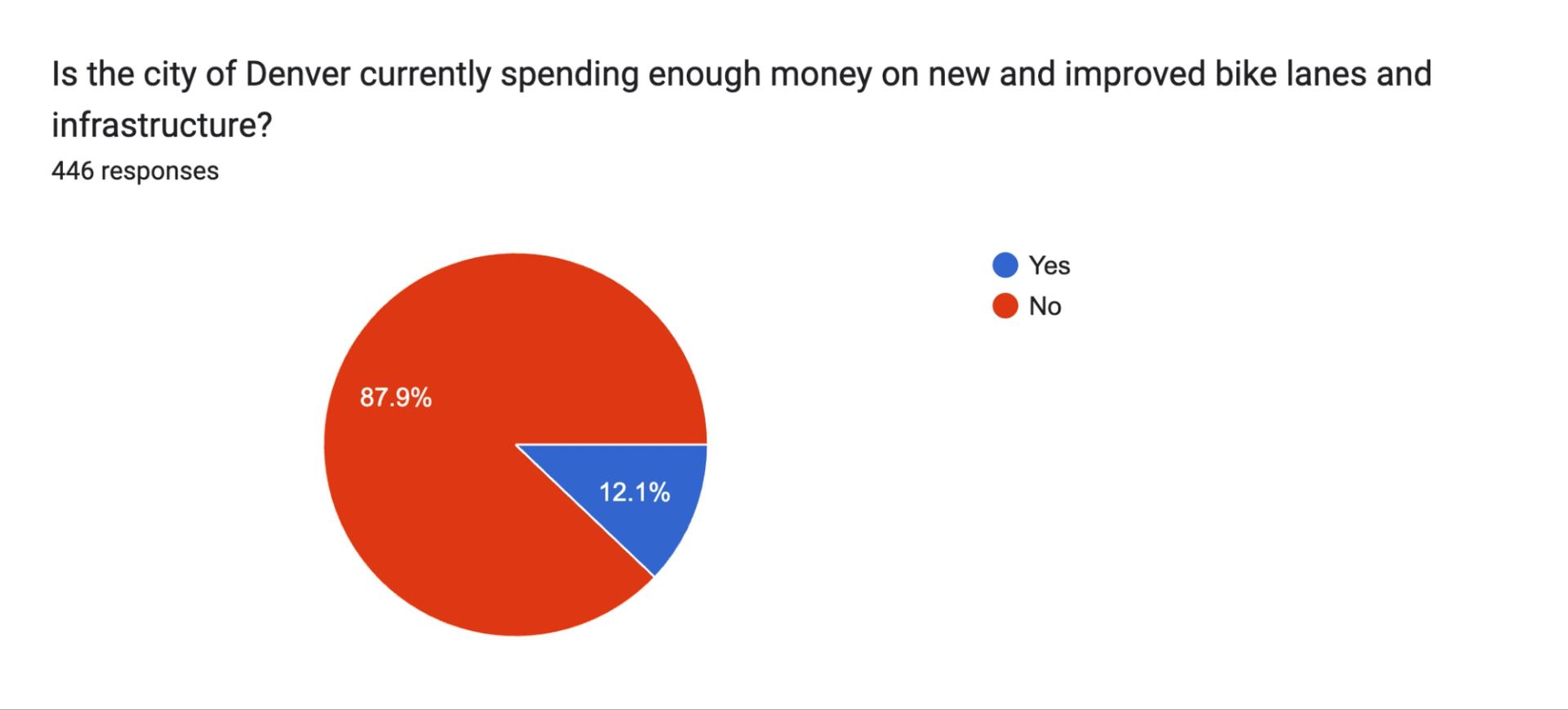
Most seem to agree on one thing: more money (87.9% said the City of Denver isn’t spending enough on new and improved bike lanes and infrastructure).
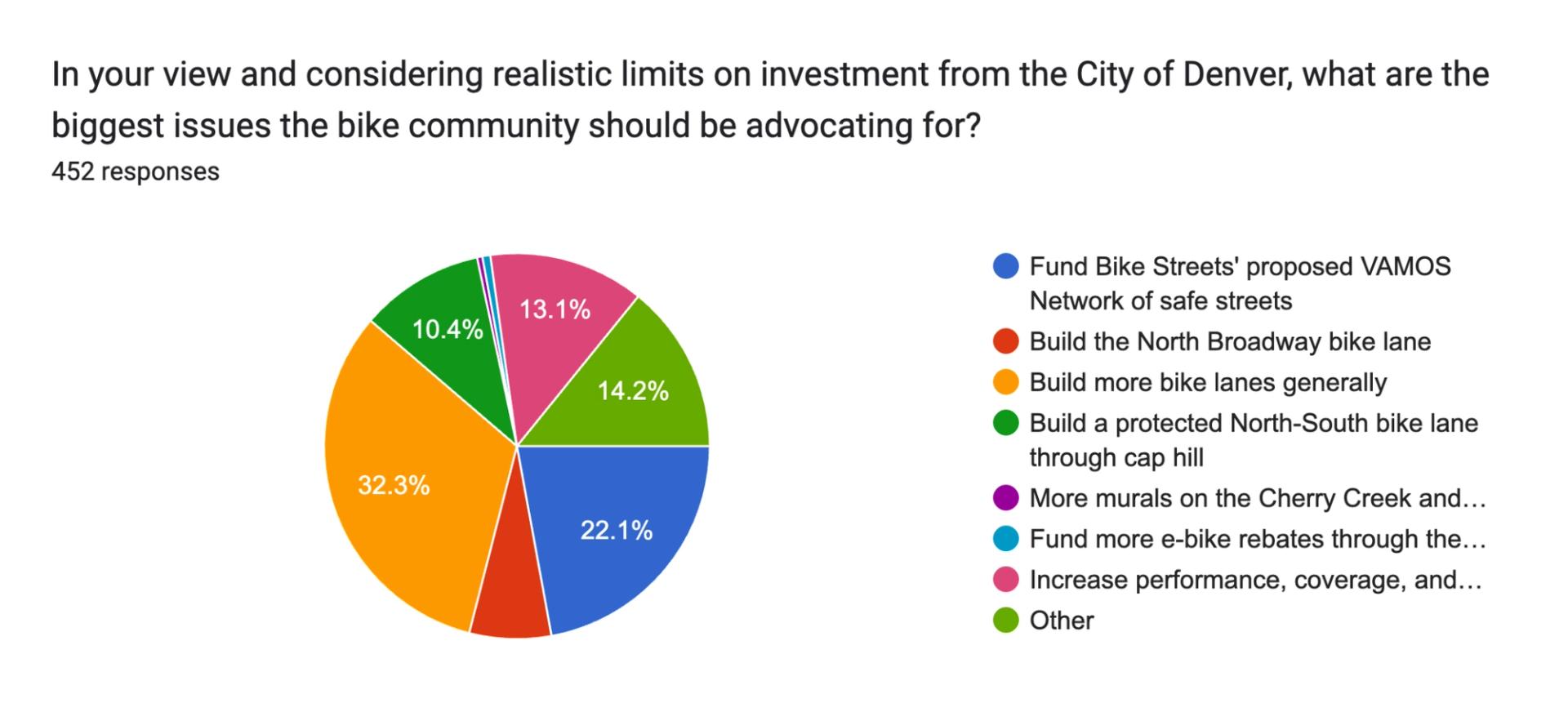
But beyond that, the respondents are divided on what they think the bike community should be advocating for – 32.3% said they think advocates should focus on generally getting more bike lanes built, 22.1% favored pushing for funding for Bike Streets’ VAMOS network of safe streets, 13.1% favored increasing performance, coverage, and frequency of RTD, and 10.4% want to focus specifically on building a North-South bike lane through Cap Hill.
These results offer context for Denver City Council’s decision in 2025 to leave funding to complete the North Broadway bike lane out of the Vibrant Denver bond package — a priority only 31 respondents, or 6.9%, said should be the community’s top priority.
Respondents writing in under "other" called for protected lanes replacing sharrows, diverters on neighborhood bikeways, closing Wynkoop to cars, and better enforcement against cars parked in bike lanes.
Tafoya, these results were not a surprise. “[It is] clear that real protective infrastructure is what people want and have wanted for a long time.”
Tafoya adds, “The incomplete network of bikeways, especially North/South, is something that I have thought/advocated for — for a long time! E-bikes have made traveling the extra distance to a safer path take less time for the detour, which is positive.”
He also pointed to two recent successful ballot measures as possible precedents for obtaining additional funding (e.g., Denver Deserves Sidewalks and 2A for Parks). “We really just need political will to push the plans to completion.”
Let’s Get to The Fun Stuff!
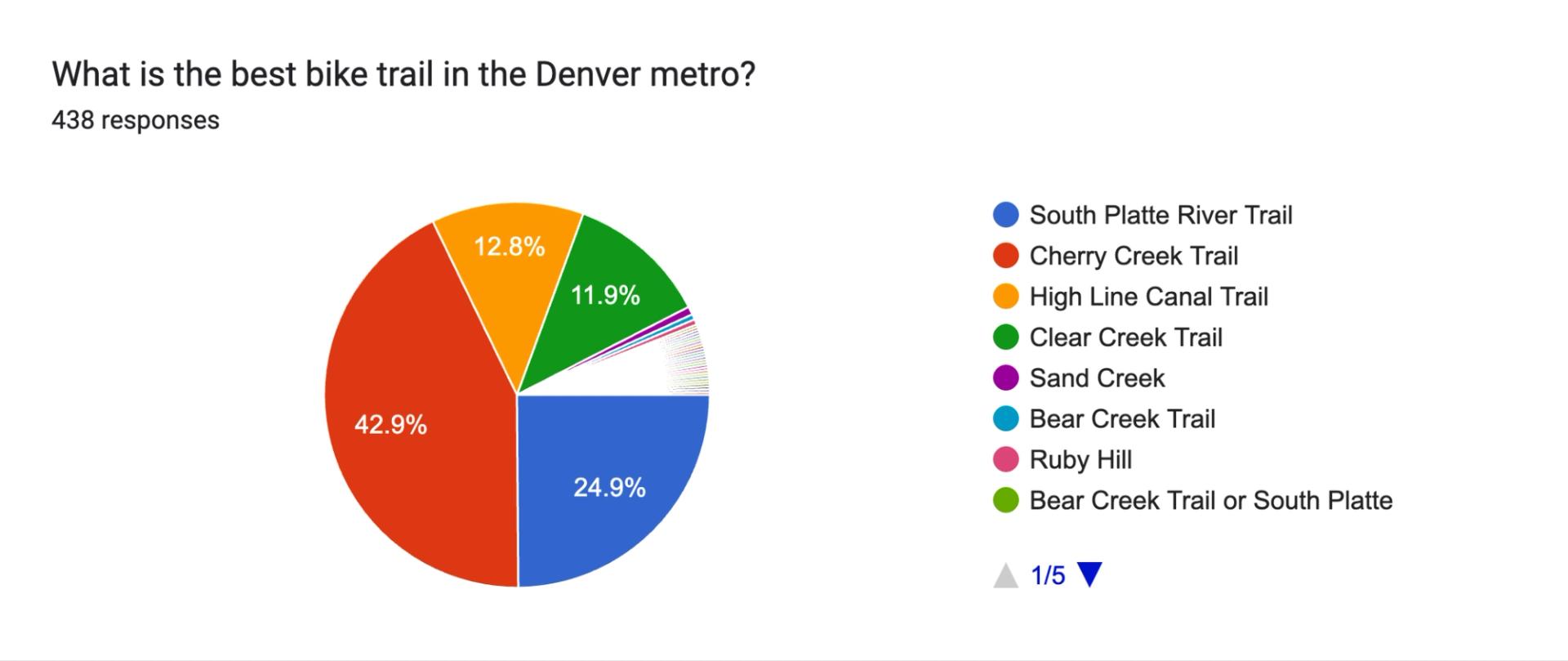
By far the most popular bike trail in the Denver metro area is the Cherry Creek Trail (42.9%), with the South Platte River Trail (24.9%), High Line Canal Trail (12.8%) and Clear Creek Trail (11.9%) rounding out the list.
Interestingly, though, multiple respondents called out one specific stretch of the Cherry Creek Trail — that part along 1st Avenue next to the country club) as the bike infrastructure most urgently in need of a fix. Those respondents are in luck — the Department of Transportation and Infrastructure is working on it.
Who is Denver’s Biggest Bike Celebrity?
Many respondents couldn’t name a Denver bike celebrity and others rejected the idea of celebrity in this context entirely, but of the 230 responses to this question, a few names rose to the top. The responses ranged from policy advocates to beloved local characters, which required some aggregation — one person was separately described by name, nickname, and distinguishing characteristic:
- AJ Anaya — 34 mentions. The Ruby Hill and Barnum bike park figure dominated the list, reflecting the strong representation of the dirt jump and BMX community in the survey.
- June Churchill — 25 mentions. The bike advocate and community figure drew consistent recognition across the survey's respondent base. June recently announced a run for City Council District 10 (Full disclosure, June also advised on the creation of this survey).
- The Penny Farthing Guy (aka, Paul Brekus) — 18 mentions. The north Denver fixture, who rides a Victorian-era penny-farthing bicycle around the city, was described variously as "the penny farther guy with the tuxedo shirt," "Paul on the penny farthing," and simply "Mr. Pennyfarthing." He was the subject of a 2021 Denver Post profile and may be Denver's most beloved bike eccentric.
- Emily Kleinfelter — 16 mentions (tied). The creator of the popular @bike.this.city social media account, known for her coverage of Denver cycling. Emily is also the lead organizer of Denver Bike Fest.
- Avi Stopper (Bike Streets) — 16 mentions (tied). The founder of the Bike Streets app and VAMOS Network proposal, cited both by name and by his organization.
Honorable mentions: Allen Cowgill and the Brown Bike Bus (13 mentions), Amy Kenreich (9), Jude Tibay (9), Brad Evans (6), Alejandra Castañeda (6), Troy McMurray (6).
Another note on the respondents: There's a clear cultural split in the respondent pool between the road/commuter cycling crowd (mostly focused on protected lanes, VAMOS, Cap Hill) and the dirt jump/park community (e.g., AJ Anaya, Troy McMurray, Ruby Hill, Barnum). They have almost entirely different concerns, and it's worth acknowledging that the poll captured both communities.
What’s So Great About Biking in Denver?
When asked to name their favorite thing about biking in Denver, many respondents mentioned the temperate weather and riding bikes with family, but “experiencing the city” rose to the top as a resonant theme across the responses. Emblematic of this sentiment, one respondent said their favorite thing about biking in Denver is “the way it changed my mental map of the city. I notice and discover so much more than I ever did behind a windshield.”
But there were so many specific and thoughtful responses to this question! We have presented a few of our favorites below, but you are welcome to peruse the entire spreadsheet of responses and find your own takeaways. This survey is meant as a resource to elevate the public dialogue around biking and inform policy-makers, but also a reminder: Biking is fun!
"The thrill of knowing I have once again cheated death whenever I make it to my destination without getting flattened by an SUV"
“Being able to ride from Golden all the way into Denver, and beyond, on a network of (usually) great bike paths and protected lanes. It’s safe, fun, and one of the things that makes Denver special.”
"Seeing the baby geese on the Platte trail and avoiding their angry parents"
"It's flat and it’s great biking weather like eight months out of the year. Even in depths of winter, a lot of those days are actually not terrible unless it is actively snowing. If my destination is in the main core (Cap Hill, Baker, Uptown, Downtown, Highlands, RiNo-ish area) it's genuinely faster for me to bike than drive. the next neighborhoods over (Sloans Lake, Congress Park, Cherry Creek, Sunnyside, etc) it's a little slower but you can almost always park your bike directly in front of the destination, so if parking sucks it ends up being about the same. But I just love how cruisy and fun biking is. You cover way more ground than walking but you're not detached from the world around you like in a car. you can appreciate buildings and things on the street and interact with people that you would just zoom by in a car."
“All three of my kids go to schools downtown and the bike is by far the best way to do school drop off!”
“Zipping by I-25 traffic on the platte trail while trying not to breathe the fumes"
"Being FREE of the shackles of personal automobile ownership. Where to park, gas prices, paying for parking, traffic congestion, insurance, maintenance ... Ohh to never think about those things is heavenly!"